On the fourth Thursday of November, American families come together to celebrate Thanksgiving, one of the year’s most important holidays. But what if the event took place in the wartchmaking world? Who would come for dinner at Patek, TAG Heuer and company? Whatever the seating arrangements, there’s bound to be turkey on the menu. News from Wthejournal
The new Sinn 910 Anniversary celebrates the brand’s 55-year history with style via a handsome limited edition split seconds chronograph that is one of the coolest pieces we saw at Baselworld 2016.
The article Sinn 910 Anniversary Limited Edition Split Second Chronograph Hands-On first appeared on aBlogtoWatch and was written by James Stacey.
The new Sinn 910 Anniversary celebrates the brand’s 55-year history with style via a handsome limited edition split seconds chronograph that is one of the coolest pieces we saw at Baselworld 2016.
The article Sinn 910 Anniversary Limited Edition Split Second Chronograph Hands-On first appeared on aBlogtoWatch and was written by James Stacey.
— With a launch calendar spread across the year, there is plenty to look forward to from Hysek in 2016.
With its own distinctive designs and a very high level of vertical integration Hysek likes to forge its own path, and the brand’s separate stand next to the Palace during Baselworld is the perfect example. But what can we expect from Hysek this year? The answer is something for everyone and in all shapes and sizes.
The most beautiful
Kalysta means “the most beautiful” in Greek and is the new Hysek ladies’ watch that has been three years in the making. It is the brand’s first jewellery watch and features a new in-house complication that dispenses with hands to display the time instead using a jumping-hour indication at 12 o’clock and a red sapphire that moves around the circumference of the dial for the minutes. This takes place against the background of a powdered-white dial with a floral engraving. A diamond-studded butterfly is applied at the centre of the dial and complements the 39mm case in red-gold with a snow setting of diamonds. This version of the Kalysta is powered by Hysek’s HW61 self-winding movement with 39 hours of power reserve. Other versions will be available with a quartz movement and different stone settings, from the full snow setting to a discreet single row of diamonds.
Decidedly square
The Furtif Skeleton Tourbillon has been completely redesigned to stay truer than ever to the brand’s desire to have nothing but the essential in its skeleton watches. The result is a 44mm square case dominated by two sapphire crystals to give a full view of the minimalist movement. But the quest for maximum visibility brings its own problems, since the bevelled crystals themselves are quite thick and extremely difficult to produce. Furthermore they have to be drilled through so that they can be screwed to the case and if that was not complicated enough, the lower crystal is curved to fit to the shape of the wrist. Imposing articulated lugs in the typical Hysek style ensure that this decidedly square watch nevertheless sits perfectly on the wrist. This 30-piece limited edition uses the HW15 calibre with the brand’s characteristic diagonal going train arrangement, with the tourbillon top left and barrel housing bottom right.
Entering a new decade
Hysek’s Abyss collection starts its second decade with three brand new self-winding tourbillon models with big date, available in red gold, red gold and black PVD or titanium. The emphasis on these models is on transparency, with all the workings visible from the front and back, including the tourbillon at 10 o’clock and the two aluminium date discs at 2 o’clock. Those with a keen eye for detail will note the unusual power reserve indicator at 6 o’clock, which, like all Hysek hands, is produced in-house, but in this case simply because no other supplier was capable of producing this curved three-dimensional design that blends in perfectly with the intricately skeletonized movement components beneath it. Power comes from the self-winding Hysek HW 03A movement, which offers approximately 68 hours of power reserve. Each of the three models is limited to 88 pieces. A colourful new chronograph version is also available in the Abyss collection.
Last but not least, let’s not forget that Hysek is one of just a handful among hundreds of high-end watch brands that offers a central tourbillon. Those who couple it with a jumping hour are even fewer. Hysek promises a new version of this rare complication later this year…
A
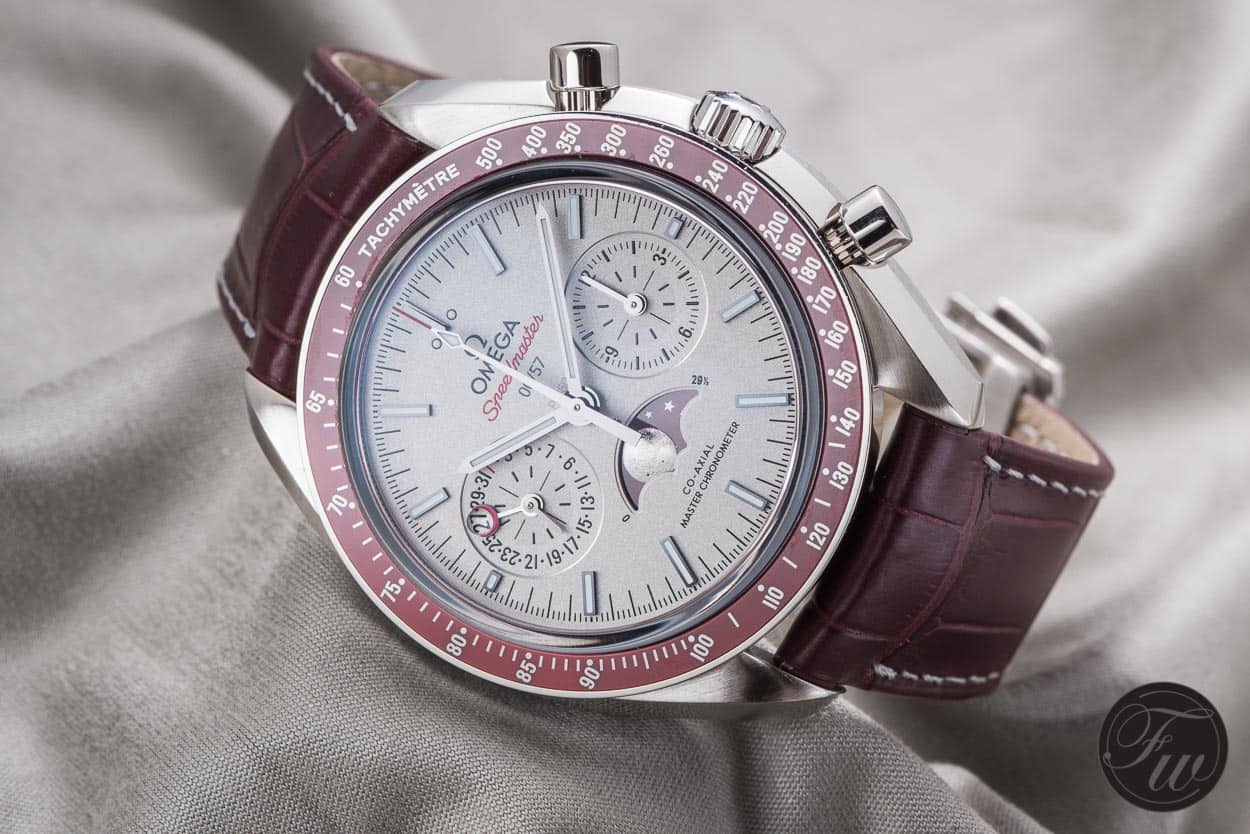
few Speedy Tuesdays ago, we showed you the new Omega Speedmaster
Moonphase Co-Axial Master Chronometer collection, except for the version
in platinum. This limited edition of 57 pieces only (referring to 1957,
the founding year of the Speedmaster collection), with a case made of
platinum, using red liquidmetal(tm) for its bezel and has a platinum […]
“If I tell you I’m a good guy, you might not believe me,” says
Mauro Maggiore, International Training Coordinator at Omega, “but if
someone else tells you that, you’re more likely to.”
Maggiore
isn’t trying to win friends. He’s using the metaphor to explain Omega’s
Master Chronometer certification, a mark of quality that is confirmed
by a Swiss government agency. It’s all well and good to say your
company’s timepieces are robust and accurate, but if an independent
third party verifies this, it carries far more credibility.
The
concept isn’t new. Watch companies have been seeking validation for
centuries, dating back to the accuracy competitions and certifications
handed out by observatories in Kew, Geneva, Neuchâtel and Besançon. And
while the mechanical watch has been largely rendered as a fashion
accessory in an age of atomic clock-accurate smartphones, brands still
tout the precision and durability of their creations.
But even
within the rarified air of the accurate timepiece, there is room for
further distinction, which has led to multiple standards, all of which
go beyond mere accuracy to prove a watch’s resistance to shock, water
and magnetism, and some its provenance and attention to detail. COSC
The
most widely known quality standard in the watch world is the one upheld
by the Contrôle Officiel Suisse des Chronomètres, or COSC. This Swiss
independent agency was formed in 1973 to oversee the standardized
testing of watch movements for accuracy, with those that pass having the
distinction of being called a “chronometer,” a previously generic term
that applied to highly accurate timepieces suitable for celestial
navigation.
COSC tests individual uncased movements for fifteen
days, fitting them to a generic dial and hands while checking their
average daily rate, variation and stability (in five positions),
resistance to minor shocks, and stability at three temperatures.
Movements that pass the test must maintain an average daily rate of
minus 4 to plus 6 seconds over a 24-hour period when compared to two
atomic clocks. These successful movements are then worthy of the
chronometer certification, the resulting documentation of which is
stored at the manufacturer’s archives and can often be requested by a
watch’s owner.
Many of the top Swiss brands submit their movements
for COSC certification, the largest being Rolex, followed by Breitling,
and several others. The British marque Bremont submits all of its
movements for chronometer testing, including its latest creation, the
Solo 32, a ladies’ wristwatch that debuted at Baselworld 2016. It is
more difficult for smaller mechanical movements to maintain accuracy, so
the achievement of the new 32-millimeter Solo is something about which
Bremont is particularly proud. Superlative Chronometer
If
“chronometer” is a household term, much of the credit can be given to
Rolex. Since the early part of the 20th century—in effect, at the very
beginning of the wristwatch— Rolex has been focused on distinguishing
its watches as both reliable and accurate. In fact, the brand bears the
distinction of having made the first wristwatch to be awarded the
prestigious Swiss Certificate of Chronometric Precision by the Official
Watch Rating Center in Bienne, as well as a class A precision rating
from England’s Kew Observatory.
By
the 1950s, most Rolex watches bore the term “Superlative Chronometer,
Official Certified” on their dials, and to this day the greatest number
of movements certified by COSC are from Rolex. But in an effort to
separate itself from the rest of the chronometers of the world, Rolex
upped the ante, creating its own “Superlative Chronometer” criteria.
After achieving COSC certification, a Rolex movement is then cased up
into a complete watch and then retested. Only after additional
temperature and position testing does a Rolex watch earn the
“Superlative Chronometer” rating. Master Chronometer
Just
down the road from Rolex in Biel, Omega is doing its own battery of
tests to separate its own watches from the COSC herd. In fact, the
company’s Master Chronometer rating may have the most stringent testing
protocol in the world.
Like Rolex, Omega starts on an already high
level with a cased-up COSC-certified movement and then tests it in six
positions, regularly checking its accuracy at different points during
its power reserve, as well as its water resistance. But the biggest
distinction of the Master Chronometer testing process is the use of
extreme magnetic fields. OMEGA measures the watches’ accuracy and
function both during and after exposure to 15,000 Gauss (1.5 Tesla) of
magnetism, roughly the equivalent of a magnetic resonance imaging (MRI)
medical device. After this battery of tests, the watch must still be
able to achieve a mean daily rate between 0 and plus 5 seconds in order
to be called a Master Chronometer.
While these extreme tests are
carried out in labs at Omega’s headquarters, they are overseen by onsite
representatives of the Swiss Metrology Institute (METAS), a government
agency that regulates standards such as units of measure. This third
party oversight lends authenticity to Omega’s claims of extreme. Omega
encourages (dares?) other brands to seek Master Chronometer
certification, but given the fact that the criteria were developed by
Omega, it’s unlikely that any will outside of other Swatch Group brands.
The
first watch to achieve Master Chronometer status was the Globemaster,
which debuted at Baselworld 2015 and was a fitting choice for Omega as
its flagship. The Globemaster takes its name from a historic watch in
the Constellation family that was renowned for its chronometric
precision. The center of the automatic winding rotor bears a medallion
depicting the Geneva Observatory where chronometer precision awards were
bestowed in the 1950s and 60s. Grand Seiko Standard
While the majority of attention for accuracy goes to Swiss brands, Seiko in Japan has its own standards for quality.
The
word, “Seiko” actually means “precision” in Japanese, and the company
takes its name very seriously. During the 1960s and 1970s, Seiko
submitted a few of its top watches for chronometer certification, but
more recently developed its own, more stringent, criteria.
The
“Grand Seiko Standard” is a label give to those movements produced under
the high watchmaking arm of Seiko. Movements are subjected to a longer
period of testing than COSC performs, mainly because Seiko tests in two
additional positions and one additional temperature, which adds an extra
two days to the process. Additionally, the average daily rate is held
to a stricter range—Seiko doesn’t allow for a loss of time over 24 hours
and mechanical movements stay within five seconds gain per day.
Grand
Seiko Spring Drive and quartz watches, like the new limited edition
SBGV019, are also tested under the same criteria and are some of the
most accurate watches in the world, achieving astounding accuracy within
only a few seconds per year. Qualité Fleurier
While
the accuracy tests done for the certifications by COSC, METAS and Grand
Seiko focus on the functioning of the watch movement and how it is
protected by its case, the Qualité Fleurier testing expands the criteria
to how the rest of the watch functions, its provenance and its maker’s
attention to manufacturing detail.
The Fleurier Quality Foundation
was established in 2001 by a joint project that included Chopard,
Parmigiani, Bovet and movement manufacturer Vaucher Fleurier in order to
affirm certain technical and aesthetic principles representative of
this important region of watchmaking.
To be certified to the
Qualité Fleurier standard, a watch must be wholly manufactured within
Switzerland—case, dial, hands, movement—and meet a number of technical
movement requirements such as the extent and degree of refinement of all
finishing, when viewed from a distance of 30 centimeters as well as
under a microscope. This includes all plates, bridges, wheels and even
screw heads. Any burrs or rough edges or unpolished screws or improper
chamfers will disqualify a watch from consideration.
In addition
to the aesthetics of a movement, cased watches are subjected to the
rigorous Chronofiable test protocol that mechanically simulates the
aging process of a watch. This includes the wear and tear of crown,
bezel, and push-piece actuation, as well as water, magnetic and shock
resistance. This “real world” simulation is not unheard of in watch
quality control but it typically is not included in any certification
requirements.
The final criteria for Qualité Fleurier
certification is the so-called Fleuritest, which goes beyond the
Chronofiable protocol to place a cased watch on a machine that simulates
seventy different common movements or gestures, from a handshake to
running to swinging a golf club, possibly made by a person wearing a
watch. A camera records the watch’s functioning during and between these
tests, and the watch’s rate analyzed. In order to pass, its rate must
fall within the range of 0 to plus 5 seconds per 24-hour period.
Only
after all of these stringent tests are performed and passed does a
watch achieve the Qualité Fleurier certification. One such timepiece is
the Parmigiani Fleurier Tonda 1950, whose slim, elegant appearance
belies the tough testing it has overcome. Poinçon de Genève
Another
quality standard that is tied to a specific region is the Poinçon de
Genève, or Geneva Seal. This stamp of approval was initiated in 1886 as a
way to distinguish the high standards for watches only made within the
Canton of Geneva.
Rather than a measure of a movement’s accuracy,
the Geneva Seal focuses only on provenance and aesthetics. The strict
criteria to which watches are held include arcane technical details such
as the types of jewels used and the thickness of the hairspring to the
minutiae of polishing and chamfering of sinkholes and pinion leaves. The
sum of these arcane parts is a watch movement that upholds the high
quality for which brands like Vacheron Constantin and Roger Dubuis are
known, even in a watch as exotic and avant-garde as the latter’s
Excalibur Knights of the Roundtable II. Patek Philippe Seal
As
arguably the most revered of the high watchmaking brands, it stands to
reason that Patek Philippe would develop its own standard, raising the
bar to a point where only its own watches can achieve compliance. The
Patek Philippe Seal encompasses all aspects of complete watches from the
Geneva-based brand, from accuracy to how precious stones are set to how
the flanks of movement wheels are finished.
Some criteria are
measurable by precision equipment, such as the mean accuracy rate of a
movement, while others are more subjective; for example, the acoustics
of all repeaters are personally assessed and approved by either honorary
president, Philippe Stern or his son Thierry, the president.
In
addition, unlike other quality standards, the Patek Philippe Seal
incorporates a customer service element, vowing to stand behind its
watches for its entire lifetime and stock repairs parts for them, or
manufacture service parts if none are available.
The Patek
Philippe Seal applies to the entire line of mechanical watches the
company manufactures, from the most basic Aquanaut to the latest
masterpiece, the Ref. 5930 world time chronograph.
Beyond
merely telling the time, watchmaking is about the quest for precision
and aesthetic excellence. And it is reassuring that, at a time when the
relevancy of the wristwatch is being challenged, the companies who make
them are continuing to raise the bar higher than ever before. It may
seem ironic that industry standards have recently served as methods to
differentiate watch companies’ timepieces instead of standardize them,
but there’s no question that the real winners of all this competition
are those of us who buy the watches.
In honor of Earth Day, we salute the watch brands that work to preserve our animals, our land and our seas. A host of watch companies take part - often on a behind-the-scenes basis - in the care and preservation of our Earth and its resources. From Rolex to Audemars Piguet, Omega, Jaeger-LeCoultre, Chopard and others - watch brands try to buy us more time with Earth's treasures. READ MORE
Round watch in polished rose gold tone featuring white textured dial with date window and slim stick hands/indices
37 mm stainless steel case with mineral dial window
Japanese quartz movement with analog display
Croco-embossed leather band with buckle closure
Water resistant to 30 m (99 ft): In general, withstands splashes or brief immersion in water, but not suitable for swimming
This dress watch from Bulova offers the beauty of rose-gold tones and the simplicity of a large dial with eye-pleasing touches. The Bulova Men’s Strap Calendar Watch boasts a croco-embossed leather strap that joins to a circular, polished stainless steel case. A rose-gold-tone stainless steel bezel frames a white dial. Slim, rose-gold-tone stick hour indicators complement slender, rose-gold-tone hands. A date window at the three o’clock position blends in discreetly with the dial. The Bulova Men
Men’s Wrist Watch Handmade by Artisan Craftsman with Real Wood. All Natural Materials (Non-toxic Hypo-allergenic)
Black Watch Box to protect your wooden watch when you are not wearing it – Protective Case
High Quality Japanese Quartz Movement- Long-lasting & ultra-quiet.
Strap made of Genuine soft brown cow leather and stainless steel silver buckle – Lightweight
Satisfaction Guaranteed – 100% Money back guarantee!
Men’s wooden watches by Woodgrain Watches. 100% Natural Bamboo Wooden Wrist Watch. Wood grain watches handmade by a professional watchmaker with genuine leather band and Quartz Analog movement. Every wood watch comes in an exclusive black gift box.
Today on “Vintage Eye,” we’re taking a look at one of the most noteworthy vintage-inspired new releases from BaselWorld 2016. Our subject is a brilliantly honest, modern re-issue of a bold, somewhat iconic, and ultra-collectible watch— the TAG Heuer Monza. WatchTime – USA’s No.1 Watch Magazine
Welcome to Point/Counterpoint, an aBlogtoWatch column where two of our resident horological aficionados duke it out over a point of contention. Last time we asked, “Is An In-House Movement In A Watch That Important?” and now, Ariel Adams and David Bredan spar over whether you should make a conservative choice or trust your instincts to get the watch you really want as your first nice watch.
The article Point/Counterpoint: Conservative Or Personal Choice As First Nice Watch? first appeared on aBlogtoWatch and was written by aBlogtoWatch.